DevOps Essentials
By reading these notes, you will gain knowledge tailored to your role, whether you are a beginner or practitioner focusing on technical foundations or a manager looking to master DevOps leadership and strategy.
>
Note - This page contains a complete summary of the topics. To learn more about each topic, click on the (***Expan******d**)* , Topic-Heading, Image, or 'Click Here' hyperlink.
1. What DevOps really is
DevOps is not just a set of tools. It is a way of working where the whole team comes together to build and deliver software smoothly. It focuses on culture, collaboration, shared ownership, and continuous learning. Developers, testers, operations, security, and management all work as one team with trust and transparency.
> In simple words, DevOps practice reduces conflicts, removes bottlenecks, improves teamwork, and helps companies deliver software faster and more reliably.
1. DevOps Pipeline
A DevOps pipeline is a step-by-step automated workflow that takes your code from development to production. It helps teams deliver software faster, with fewer mistakes, and with continuous improvements.
Typical Stages in a DevOps Pipeline End-to-End-DevOps-flow
**Plan → Code → Build → Test → Deploy → Monitor → Feedback → Repeat**
2. DevOps is a Socio-Technical System
That optimizes how people, processes, and technology work together to deliver software faster, safer, and continuously.
A socio-technical system means DevOps focuses on: -
-
Social elements → people, teams, behaviours, communication, leadership.
-
Technical elements → automation, pipelines, infrastructure, reliability engineering.
You cannot succeed in DevOps by only improving the technical side (tools), and you cannot succeed by only improving culture without technical practices.
DevOps = People + Process + Technology + Culture working together.
3. Five Dimensions of DevOps
Culture, Processes, Collaboration, Mindset, Technical Practices
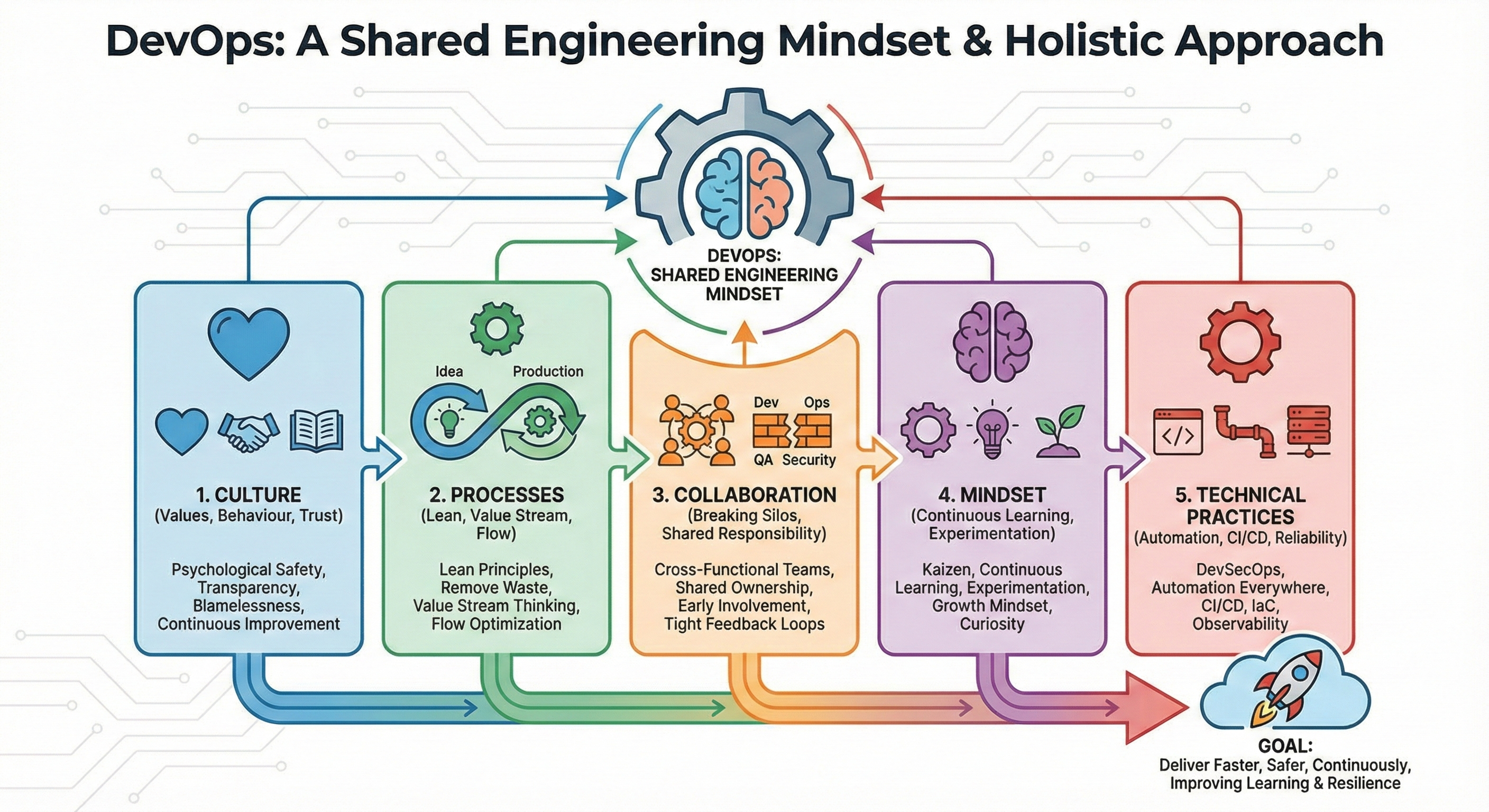
1. DevOps Culture
Anti-Patterns / Culture Failures
DevOps is culture-first, tools-later. Culture is the heart of DevOps. Without the right mindset, tools and automation are of no use.
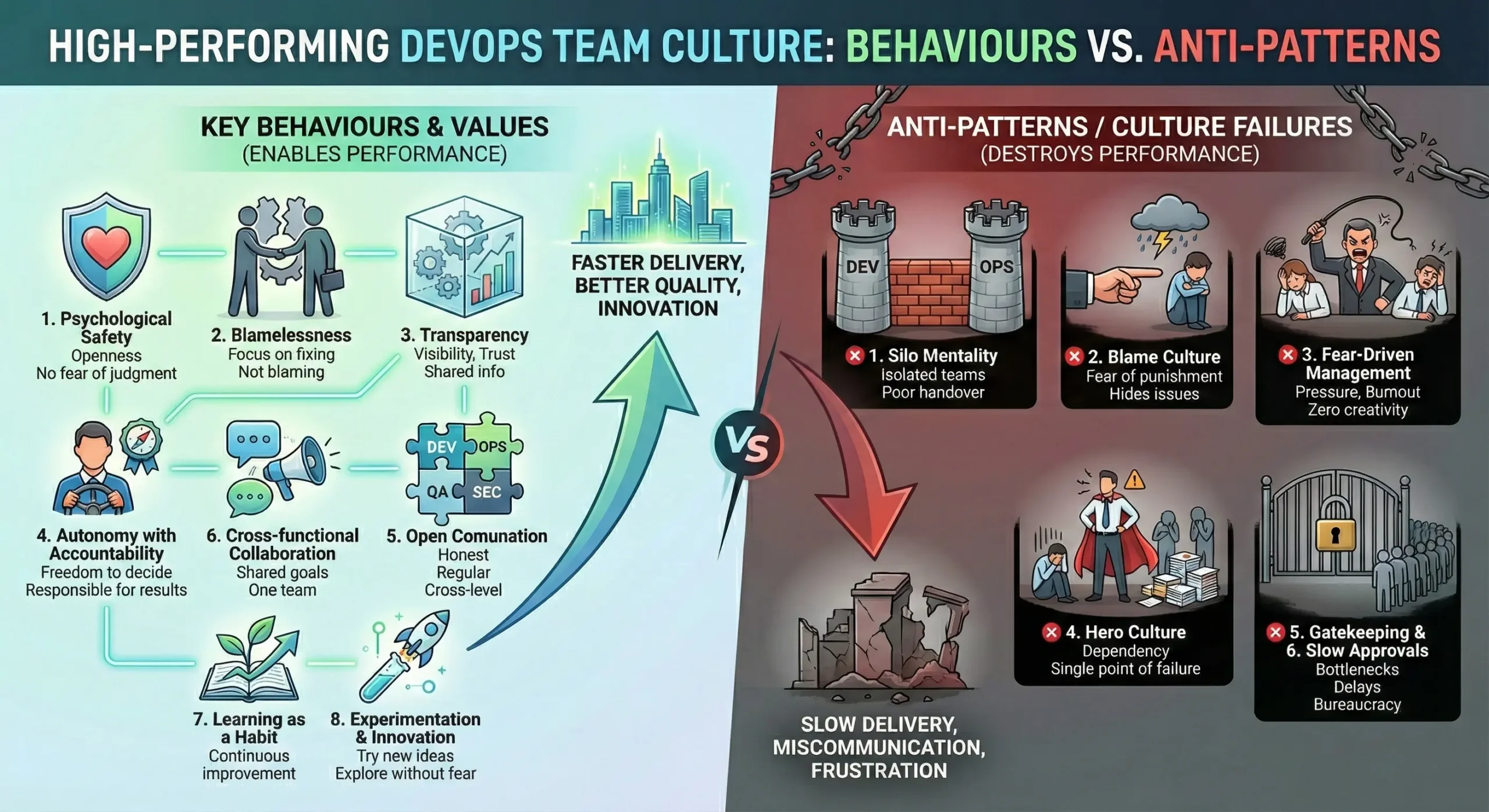 ***Culture ***
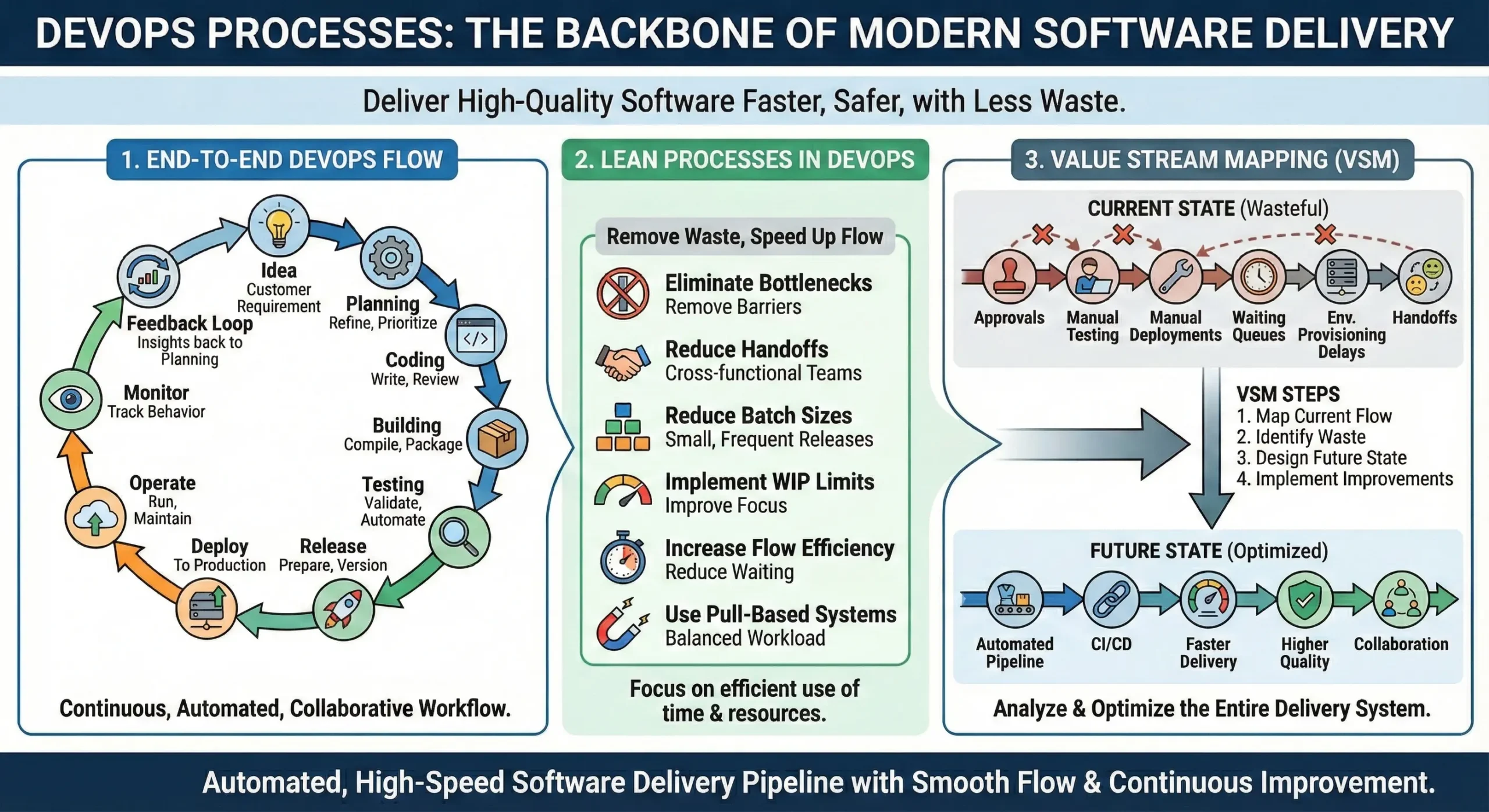
2. DevOps processes
DevOps Processes form the backbone of any modern software delivery system. They connect the work of Development, Operations, QA, Security, and Business into one continuous, automated, and collaborative workflow.
> The goal of DevOps processes is simple: - Deliver high-quality software faster, safer, and with less waste.
> > > > When these processes are implemented correctly, organizations move from slow, manual, siloed operations to fast, automated, efficient, and collaborative DevOps delivery.
-
Promote autonomy of teams
-
Visibility and Transparency
-
Understanding and Empathy
-
Configuration management
-
Release management
-
Continuous integration
-
Continuous deployment
-
Infrastructure as Code
-
Application performance monitoring
-
Test automation.
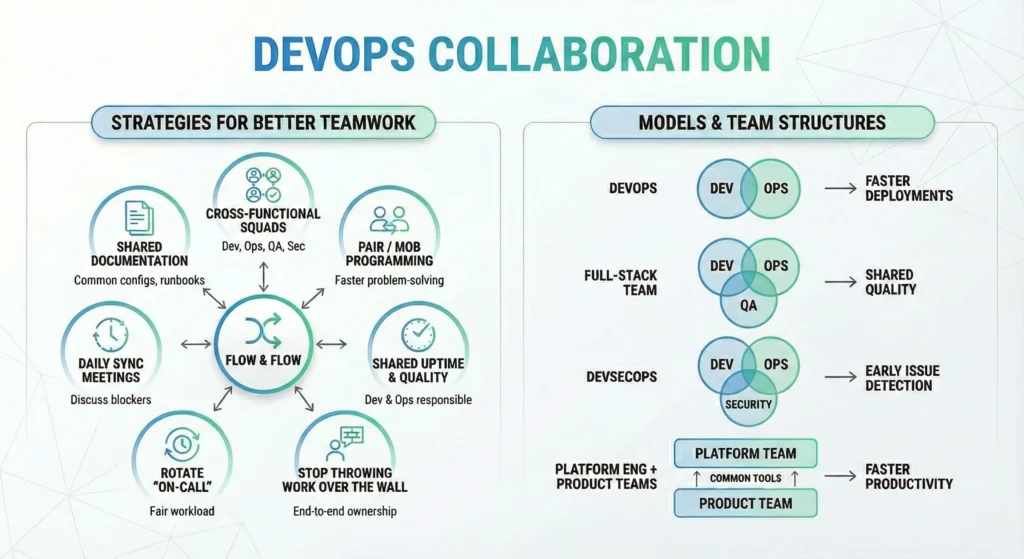
3. Collaboration in DevOps
> DevOps Collaboration = Working as One Team
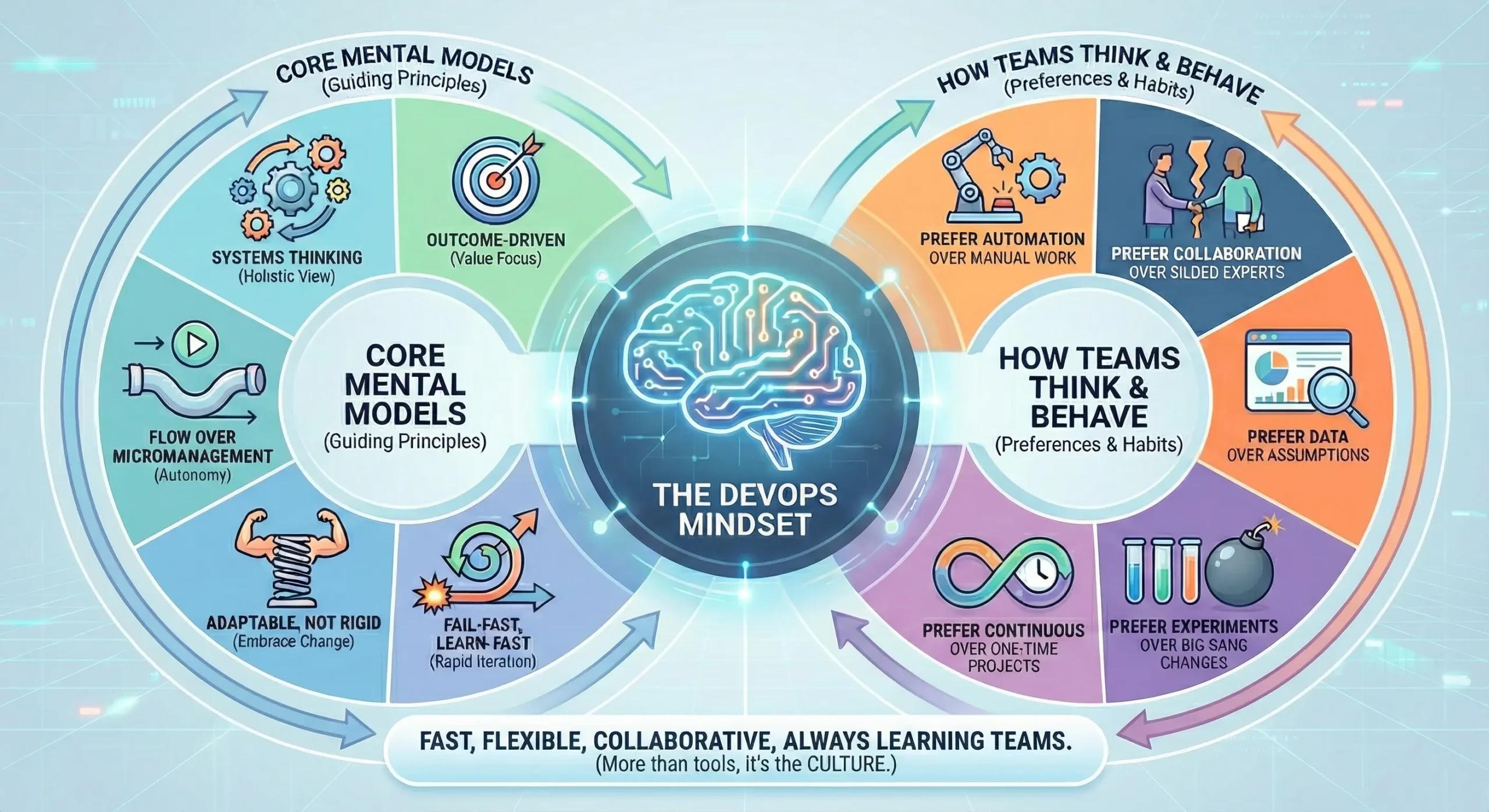
4. DevOps Mindset
The DevOps mindset is all about working together, learning continuously, automating wherever possible, and delivering value to customers quickly and smoothly. It is built on five pillars: -
> In short: - Work together → Automate smartly → Improve daily → Deliver smoothly → Focus on the customer.
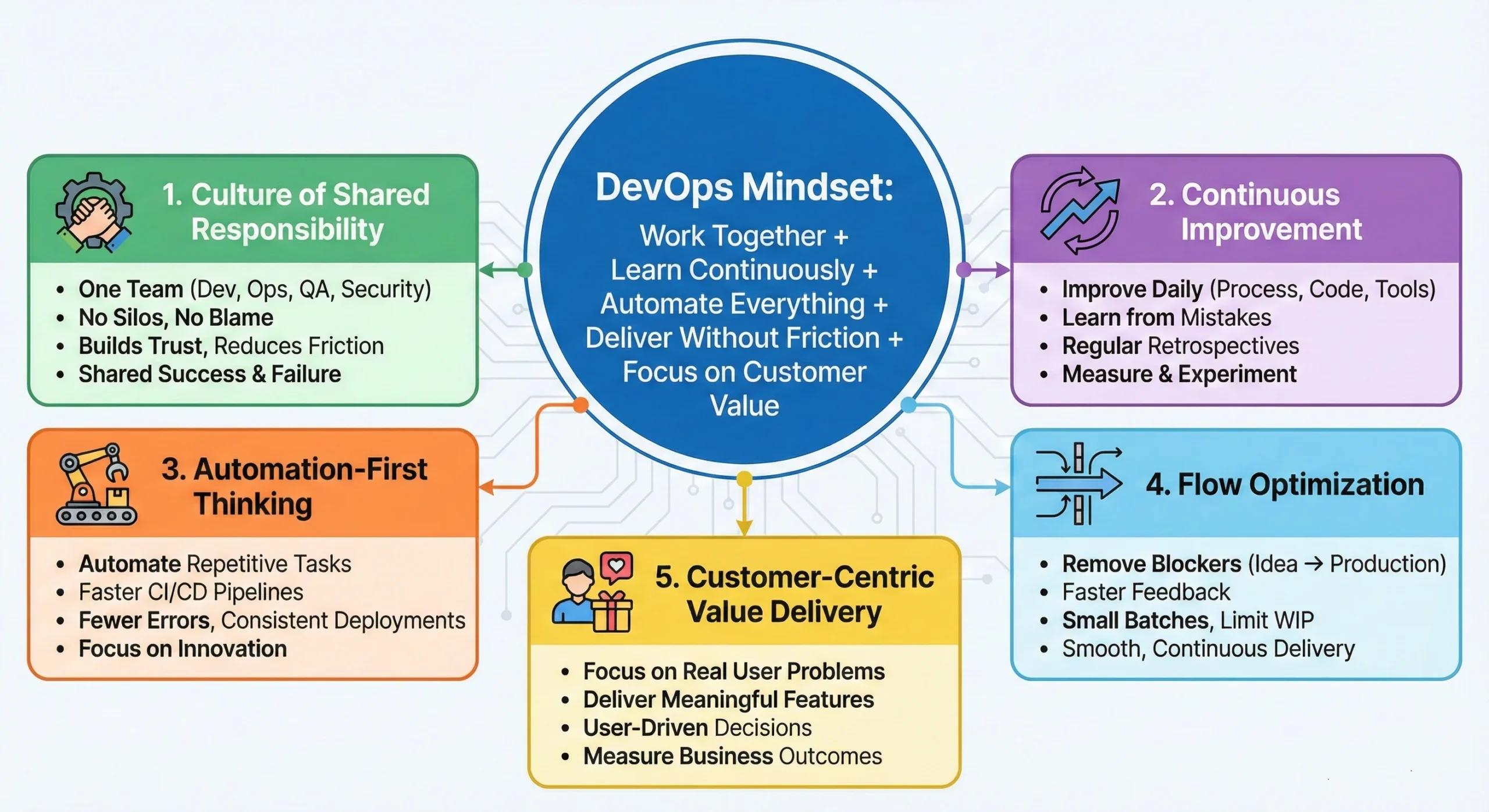
> This mindset transforms ordinary teams into high-performing DevOps teams that deliver faster, safer, and smarter.
5. DevOps Practices
> Together, these practices enable modern teams to achieve fast, safe, and reliable delivery at scale.
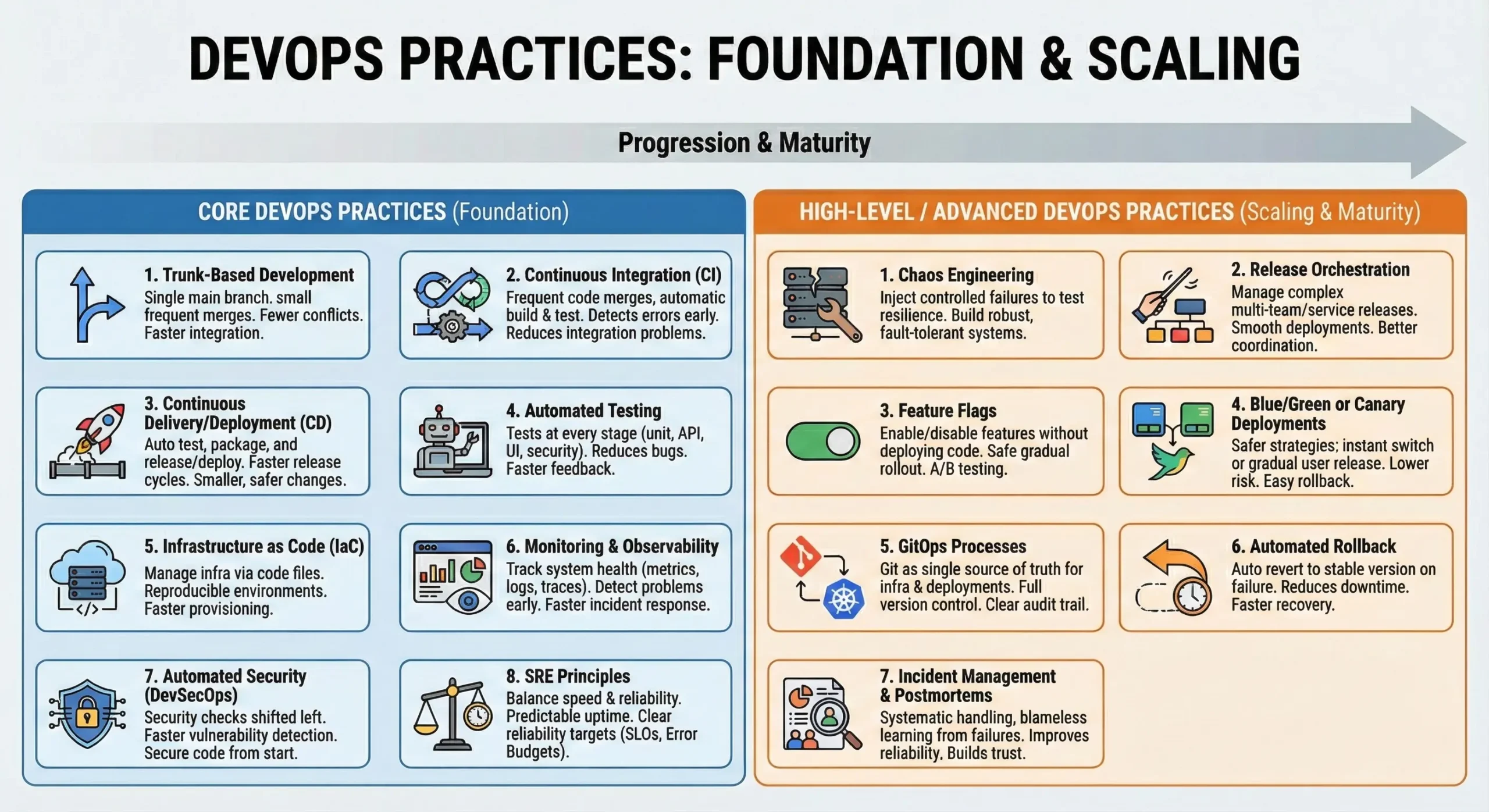
> The goal of DevOps is to Deliver high-quality software faster, safer, and continuously, while improving organizational learning and resilience.
4. Top skills of DevOps Engineer.
-
Communication and Collaborations.
-
Cloud Technologies and System Administrations (Windows and Linux).
-
System architecture and provisionary.
-
Knowledge and experience with DevOps tools.
-
Configuration management.
-
Containers and Container orchestration.
-
CI/CD Tools. Automation tools
-
Security engineer.
-
Familiarly with coding and scripting.
-
Software developer, Quality assurance
-
Management skills.
-
Release management / Change advisory board etc.
5. All “Continuous” in DevOps
In DevOps, “Continuous” means doing work in a smooth, automated, and ongoing flow without delays. Everything happens in small, frequent steps so teams can deliver faster, reduce risks, and improve quality. All these stages work together to ensure software is always ready to build, deploy, run, and improve continuously.
Here is the some common "Continuous Practice" list this list is not limited. We have many more continuous practices.
Continuous Practice.Meaning.What Happens Here.Why It Is Important.1. Continuous PlanningSmall and frequent planning.Sprint planning, roadmap updates, backlog grooming.Helps teams adjust quickly and avoid long delays.2. Continuous DevelopmentCode written in small pieces.Frequent commits, feature branches, coding standards.Faster progress, less conflicts, easy reviews.**3. Continuous Integration (CI)**Merge code often + auto build/test.Code push → build → test automatically.Catches bugs early, keeps code stable.4. Continuous TestingTesting happens automatically at every stage.Unit, API, UI, performance, security, infra tests. Code Hygiene, system test, function test, integration test, TDD, BDD, ATDDEnsures quality, reduces production issues.**5. Continuous Delivery (CD)**Software always ready to deploy.Build artifacts stored, approvals optional.Safe and reliable releases anytime.**6. Continuous Deployment (CD)**Auto deployment after tests pass.No manual approvals, small frequent releases.Very fast delivery, fewer risky changes.7. Continuous Monitoring24×7 checking of system health.Logs, metrics, alerts, APM tools.Faster issue detection, high reliability.8. Continuous FeedbackFeedback from users & systems.Monitoring data, analytics, reviews.Improves product based on real usage.9. Continuous SecuritySecurity built into pipeline.SAST, DAST, dependency scan, secret scan.Fix security issues early, reduce risk.10. Continuous ComplianceAutomated compliance enforcement.Policy-as-code, audit logs, approvals.Meets government / industry standards.11. Continuous ConfigurationConfig updated via automation.IaC (Terraform, Ansible), GitOps.No config drift, consistent environments.12. Continuous Deployment VerificationAuto-check after deployment.Health checks, logs, performance, error rates.Ensures new version is safe for users.13. Continuous ImprovementSmall improvements daily.Retrospective actions, automation upgrades.Long-term efficiency and quality.14. Continuous LearningTeams keep learning regularly.Training, knowledge sharing, PoCs.Helps teams stay modern & skilled.
6. DevOps best practices
-
Build the Artefact once and deploy many (in all the envs)
-
Artifacts should be immutable
-
Deployment should be same as Prod env in all the envs.
-
Deployment should be idempotent
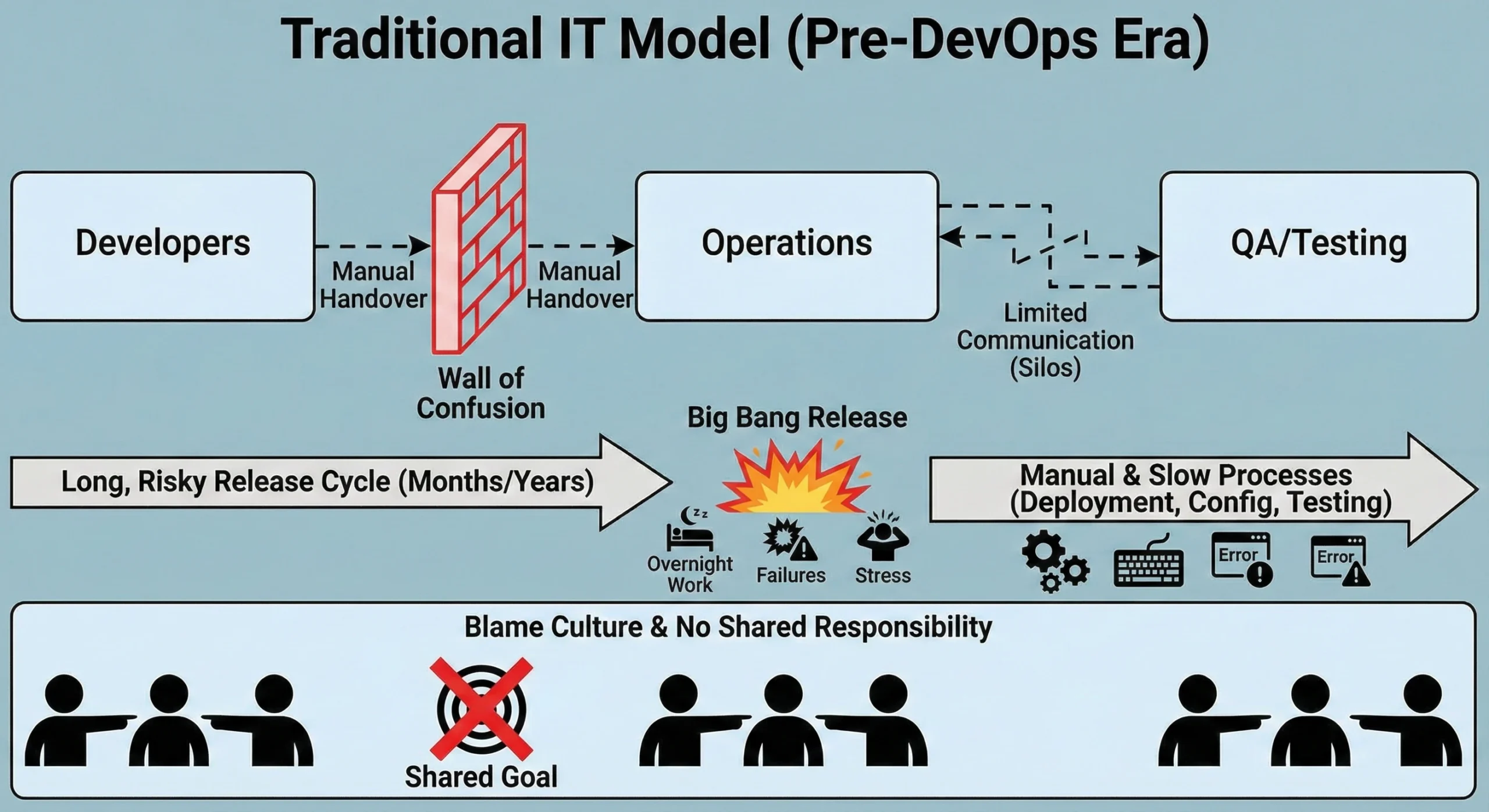
2. Life before DevOps
Before DevOps, software development was slow, manual, and full of communication gaps. Development, QA, and Operations worked in separate silos, so teamwork was very limited. Most tasks deployment, testing, server setup, and configuration were done manually, which increased mistakes and delays.
Releases were big and happened only after several months. Release days were stressful because even a small issue could bring down the system, and rolling back changes was difficult. Testing happened at the end of the cycle, so bugs came very late and fixing them cost more time and effort.
There was no continuous feedback, so developers and operations teams didn’t know what was happening in production until customers complained. Scaling the system was also difficult because servers had to be added manually.
Overall, the pre-DevOps era was marked by slow delivery, high risk, miscommunication, more bugs, blame culture, and inconsistent processes. This old way of working could not support the speed and reliability required by modern businesses leading to the need for DevOps.
For more details click here.
1. Agile vs DevOps.
Agile: - focuses on how we develop software small releases, fast feedback, and flexible changes. DevOps: - focuses on how we deliver and operate software automation, CI/CD, monitoring, and collaboration between Dev, QA, Ops, and Security.
> Together, Agile + DevOps help teams build faster, deliver faster, and run systems more reliably.
2. Traditional Model vs Agile vs DevOps.
CategoryTraditional ModelAgileDevOps1. Main FocusComplete project in big phasesFast development in small sprintsFast development and fast delivery with automation2. Team StructureTeams work in silos (Dev, QA, Ops separate)Dev + QA work closelyDev + QA + Ops + Security work together3. Way of WorkingSequential (Waterfall)Iterative, sprint-basedContinuous development + continuous delivery4. Release Frequency3–12 months (very slow)Every 2–4 weeksDaily or even multiple times a day5. AutomationVery less, mostly manualSome automation in testingHigh automation (CI/CD, IaC, monitoring)6. CommunicationLimited, slow, documentation-heavyRegular communication within dev teamStrong communication across all teams7. Feedback LoopFeedback comes lateFeedback from customers regularlyContinuous feedback from pipelines & production8. QualityTesting done at the end → many late bugsTesting included inside sprintsAutomated tests + continuous quality checks9. DeploymentManual and riskyStill partially manualFully automated, safe, repeatable10. RiskHigh (big releases)Medium (small releases)Very low (tiny releases + automation)11. Customer InvolvementOnly at final stageHigh involvement each sprintHigh involvement + real-time feedback12. ScalingHard to scaleCan scale dev workEasy to scale infra + releases13. CultureBlame culture, rigidFlexible, collaborative (within dev)No-blame, open, collaborative across whole org14. ToolsBasic tools (manual servers, docs)Planning tools (Jira, boards)CI/CD, cloud, containers, monitoring tools15. GoalDeliver product at the endFast development & quick changeEnd-to-end fast delivery, stability, automation16. Environment ManagementManual server setupPartially standardisedFull automation using IaC (Terraform, Ansible)17. ResponsibilityEach team separateShared between Dev & QAShared responsibility (Dev, Ops, QA, Security)18. Learning & ImprovementVery slowModerateContinuous improvement built-in19. Production MonitoringLimited, reactiveBasicDeep monitoring, logs, alerts, proactive20. OutcomeSlow, risky, expensiveFaster dev but slow deliveryFast dev + fast delivery + stable production
3. DevOps SDLC
DevOps SDLC (Software Development Life Cycle) is a continuous and collaborative way of building software where every team works together from start to finish. DevOps connects all stages into one smooth flow: -
-
Plan: - Teams understand requirements and create a roadmap.
-
Code: - Developers design and write code in small pieces.
-
Build (CI): - Code is compiled and validated automatically.
-
Test: - Automated tests check quality at every step.
-
Release: - Application becomes ready for deployment.
-
Deploy: - Code is deployed to environments using automated pipelines.
-
Operate: - Systems are monitored for performance, security, and stability.
-
Feedback: - Data from users and logs is analysed to improve the next release.
The process uses automation, teamwork, and small frequent releases to deliver software faster, safer, and with fewer errors. Every phase is linked, there are no silos, and teams get continuous feedback to improve the product.
> In simple words, DevOps SDLC removes delays, reduces risks, encourages collaboration, and ensures the software keeps getting better with every cycle.
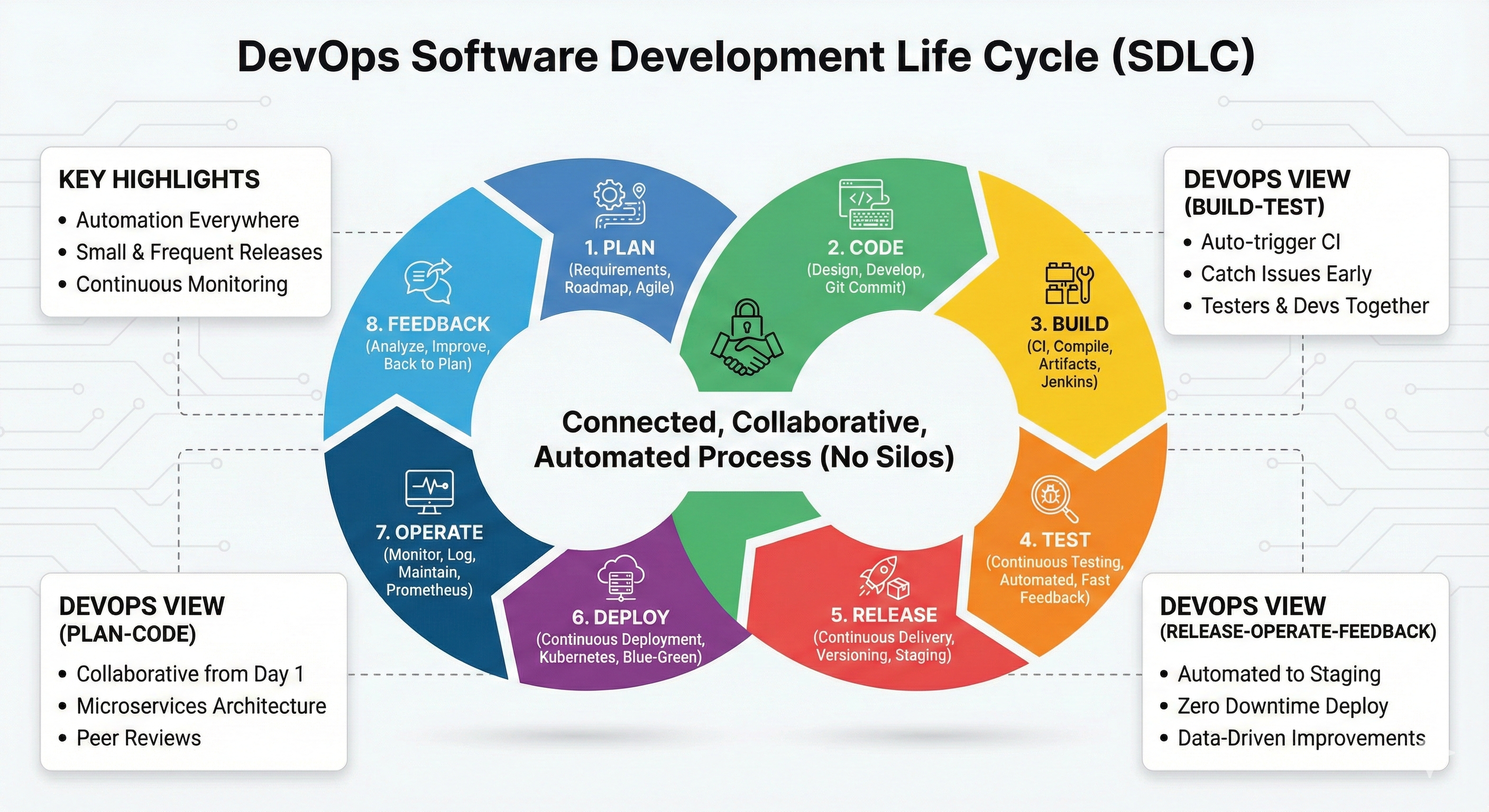
For more details click here.
4. DevOps Principles
> Together, these principles ensure that DevOps is not just a set of tools but a complete way of thinking, building, and operating modern software systems.
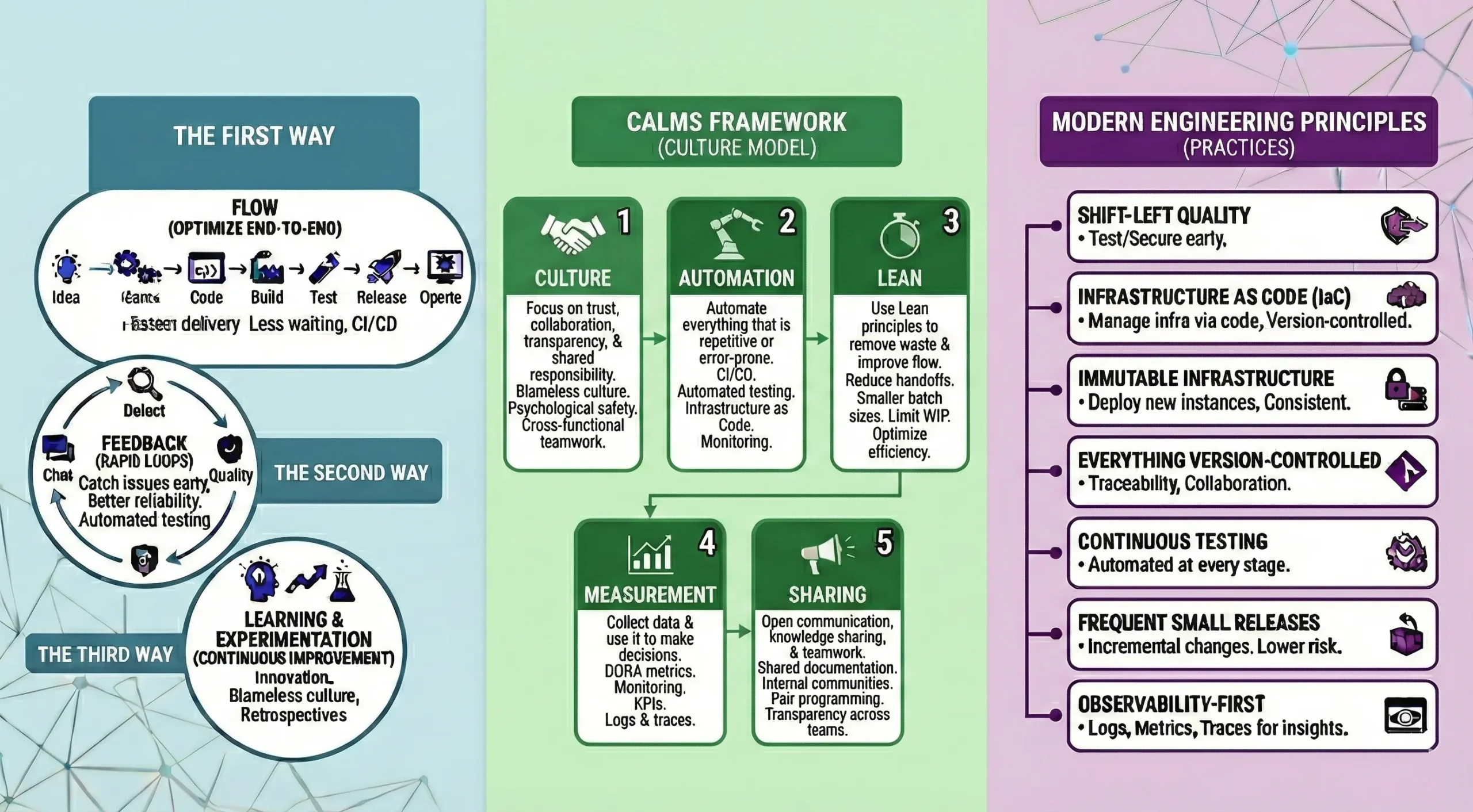
DevOps Principles provide the mindset and guidelines that help teams: -
-
Deliver software faster.
-
Reduce errors.
-
Improve quality.
-
Encourage collaboration.
-
Innovate continuously.
For more details click here
5. DevOps Adoption and Benefits
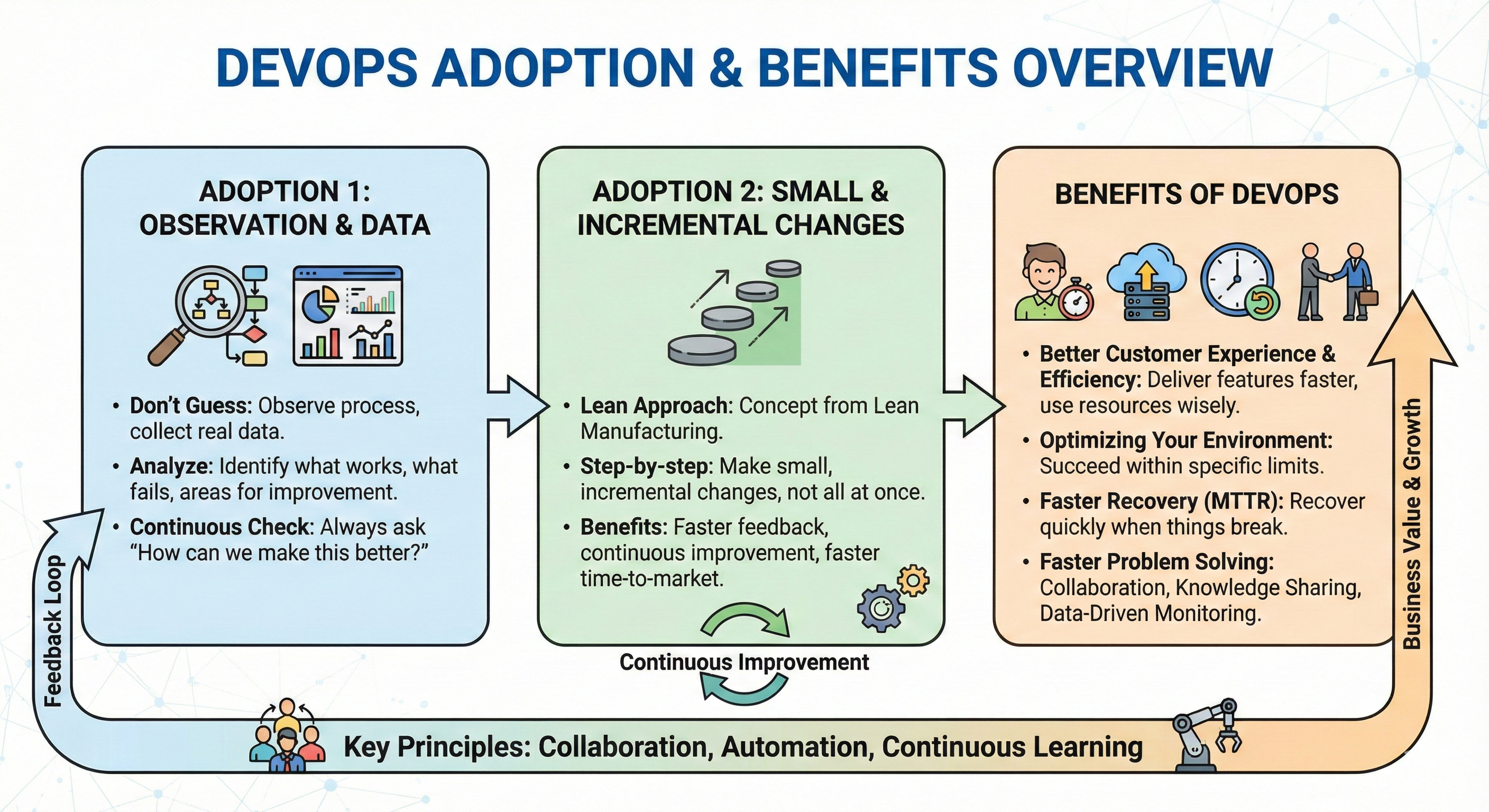
- Adoption: - Learn through observation & data.
-
Don't guess: - Observe your current process and collect real data.
-
Analyze: - Figure out what is working, what is failing, and what needs to be improved next.
-
Continuous check: - Always ask, "How can we make this better?"
- Adoption: - Small and incremental changes.
-
The Lean approach: - This concept comes from Lean Manufacturing.
-
Step-by-step: - Instead of changing everything at once, make small, incremental changes.
-
**Benefits: -**Faster feedback (you know immediately if it works). Continuous improvement. Getting products to the market faster.
- Benefits of DevOps.
-
Better customer experience & efficiency: - DevOps helps you deliver features faster to customers while using your resources (time and money) wisely.
-
Optimizing your environment: - It recognizes that every company has limits. It shows you how to succeed and perform well within your own specific environment.
-
**Faster Recovery / Mean Time to Recovery (MTTR): - **When things break (and they will), DevOps allows you to recover from problems much more quickly.
-
Faster Problem Solving: - Teams find solutions faster because: -
-
They work together (Collaboration).
-
They learn from each other (Knowledge Sharing).
-
They track performance using data (Monitoring).
-
Increase speed of recovery
-
Cost reduction
-
Security auditing and monitoring
-
Security by Design
-
Every responsible for security
-
Tear down infrastructure
6. DevOps Metrics
> Using these metrics, teams can make data-driven improvements, avoid guesswork, and build a high-performing DevOps organization.
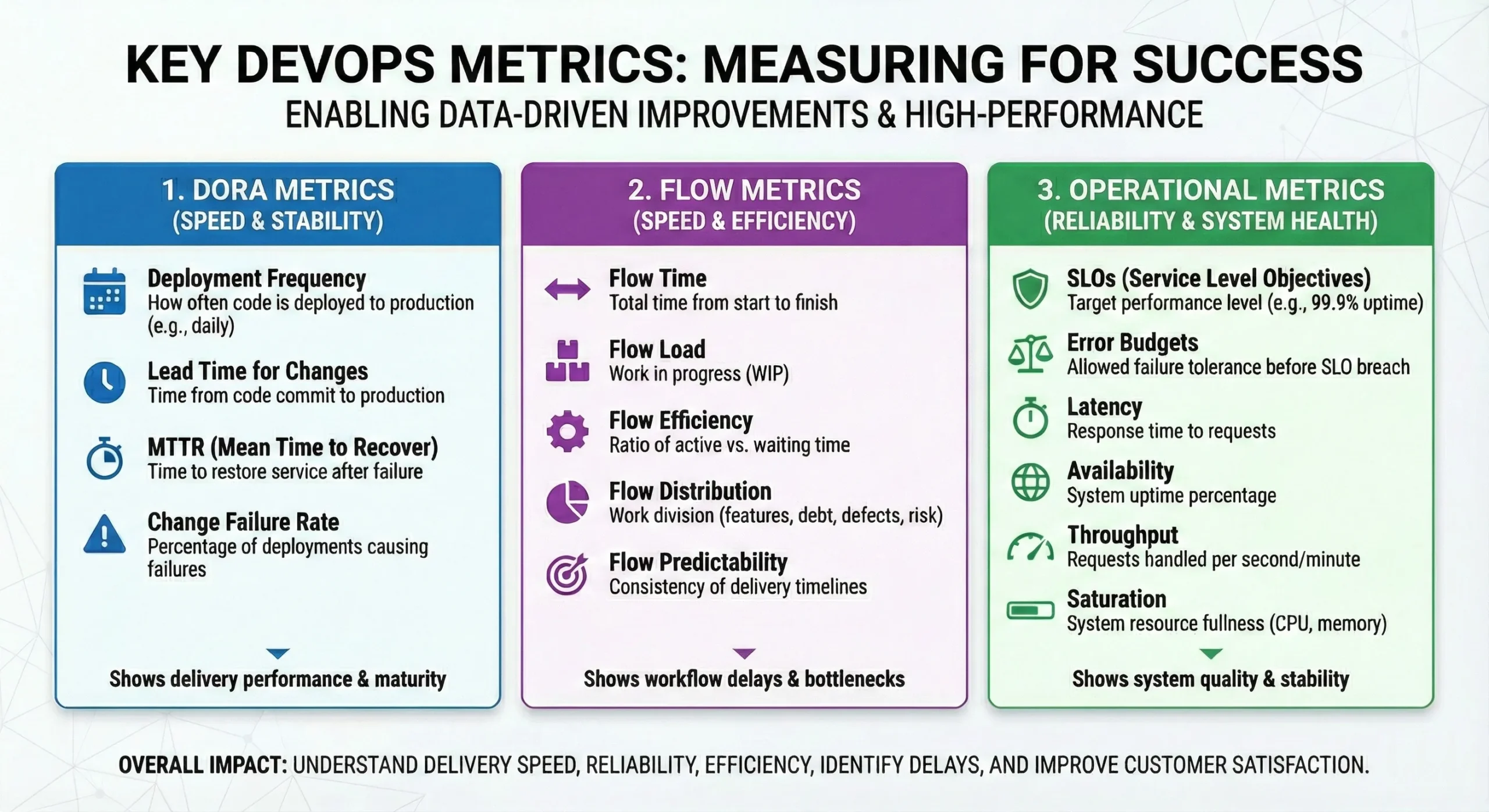
For more details click here.
7. DevOps leadership - People & Change Leadership
DevOps is not only about tools or automation it is mainly about people, culture, and leadership. Strong leadership helps teams move from traditional slow processes to a fast, collaborative, and modern DevOps way of working.
Strong DevOps leadership is about: -
-
Supporting autonomous teams.
-
Sponsoring automation investments.
-
Aligning work around value streams.
-
Enabling continuous feedback loops.
-
Emphasizing customer outcomes, not internal politics.``
-
Empowering teams.
-
Clearing obstacles.
-
Promoting learning.
-
Supporting automation.
-
Focusing on customer outcomes.
-
Encouraging transparency.
-
Driving collaboration.
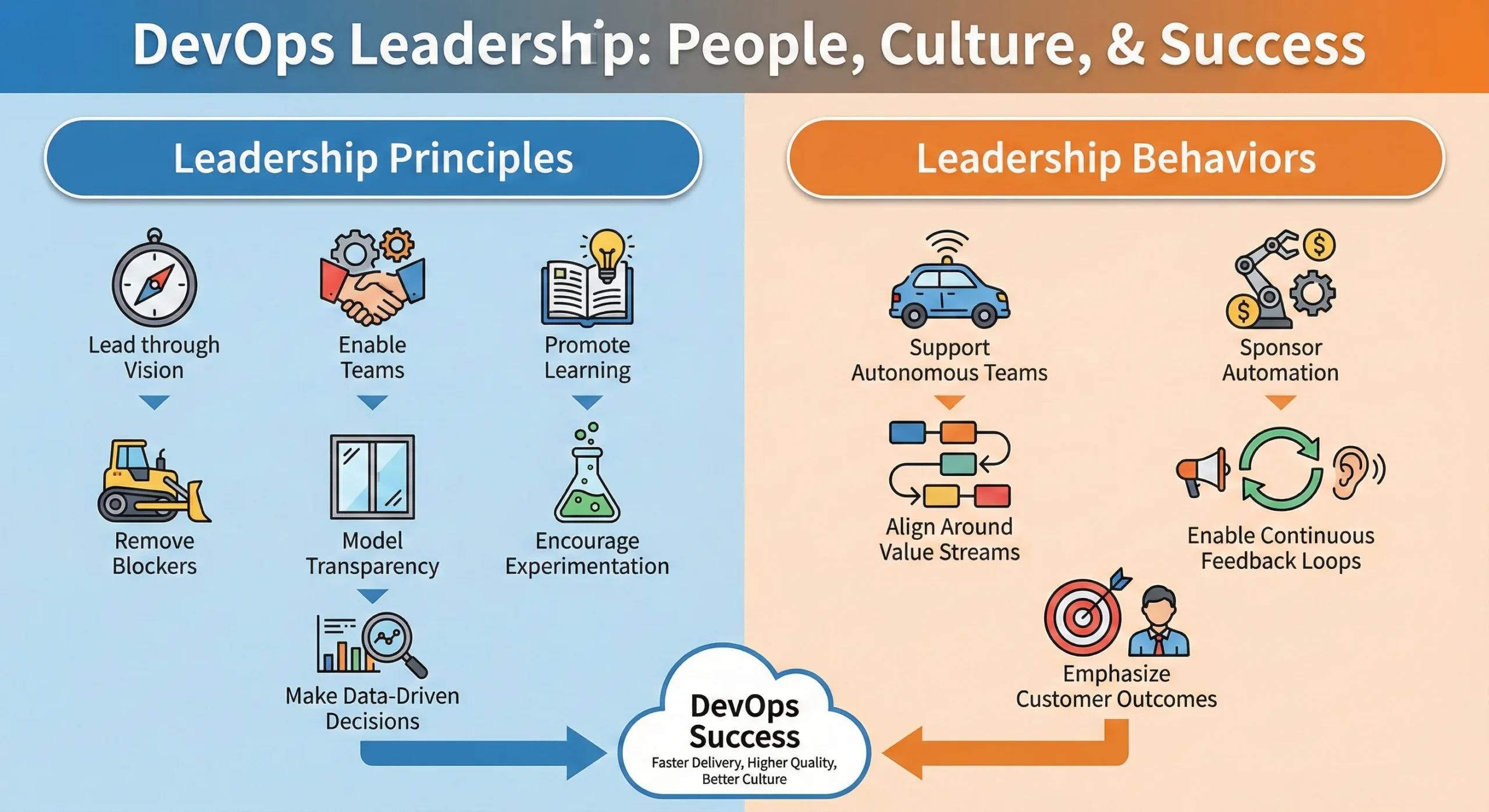
> DevOps leaders focus on guiding, supporting, and removing obstacles, instead of controlling or micromanaging.
For more detailsclick here.
8. Designing a DevOps transformation strategy
> DevOps transformation is not about tools alone it is about creating a fast, collaborative, automated, and learning-driven organization.
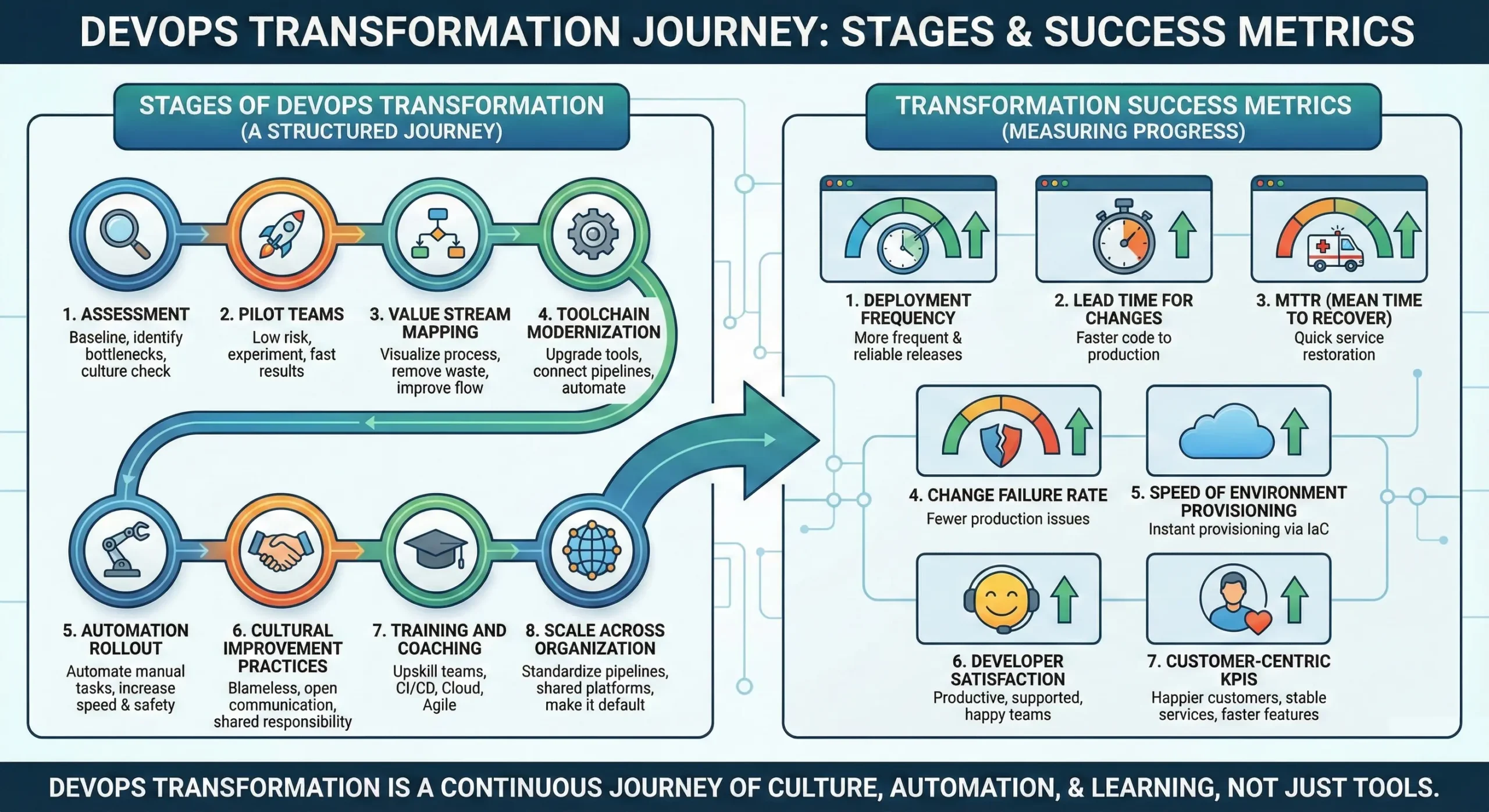
A successful DevOps transformation is built on: -
-
A clear assessment.
-
Small pilot teams.
-
Value stream mapping.
-
Modern toolchain.
-
Strong automation.
-
Cultural improvement.
-
Training and coaching.
-
Scaling across teams.
Success should be measured using real metrics like: -
-
Deployment frequency.
-
Lead time.
-
MTTR (Mean Time to Recover).
-
Change failure rate.
-
Provisioning speed.
-
Developer satisfaction.
-
Customer outcomes.
For more details click here.
9. DevSecOps - Security Embedded into DevOps
DevSecOps ensures that security is integrated into the pipeline, not added as a slow final step.
DevSecOps means integrating security into every stage of the DevOps pipeline. Instead of treating security as a separate step at the end, DevSecOps makes security a shared responsibility of everyone Developers, Operations, QA, and Security teams.
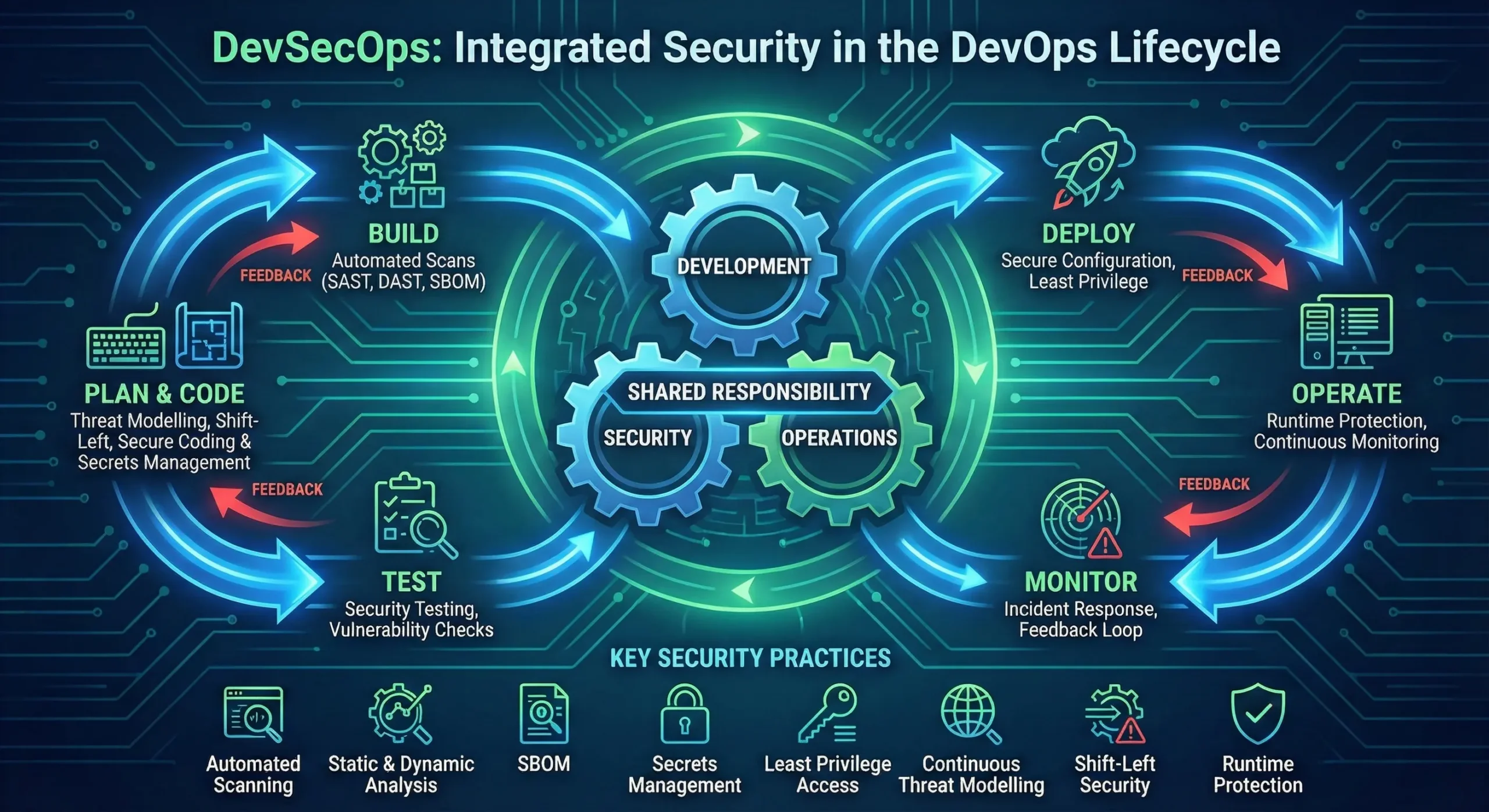
1. Key Security Practices.
-
Automated security scanning everywhere.
-
Static & dynamic analysis.
-
Scan code, dependencies, and containers.
-
SBOM (Software Bill of Materials).
-
Secrets management, protect secrets.
-
Least privilege access.
-
Continuous threat modelling.
-
Shift-left security checks.
-
Runtime protection.
-
Make security a shared responsibility.
> DevSecOps = Development + Security + Operations working together.
For more details click here.
10. Site Reliability Engineering (SRE).
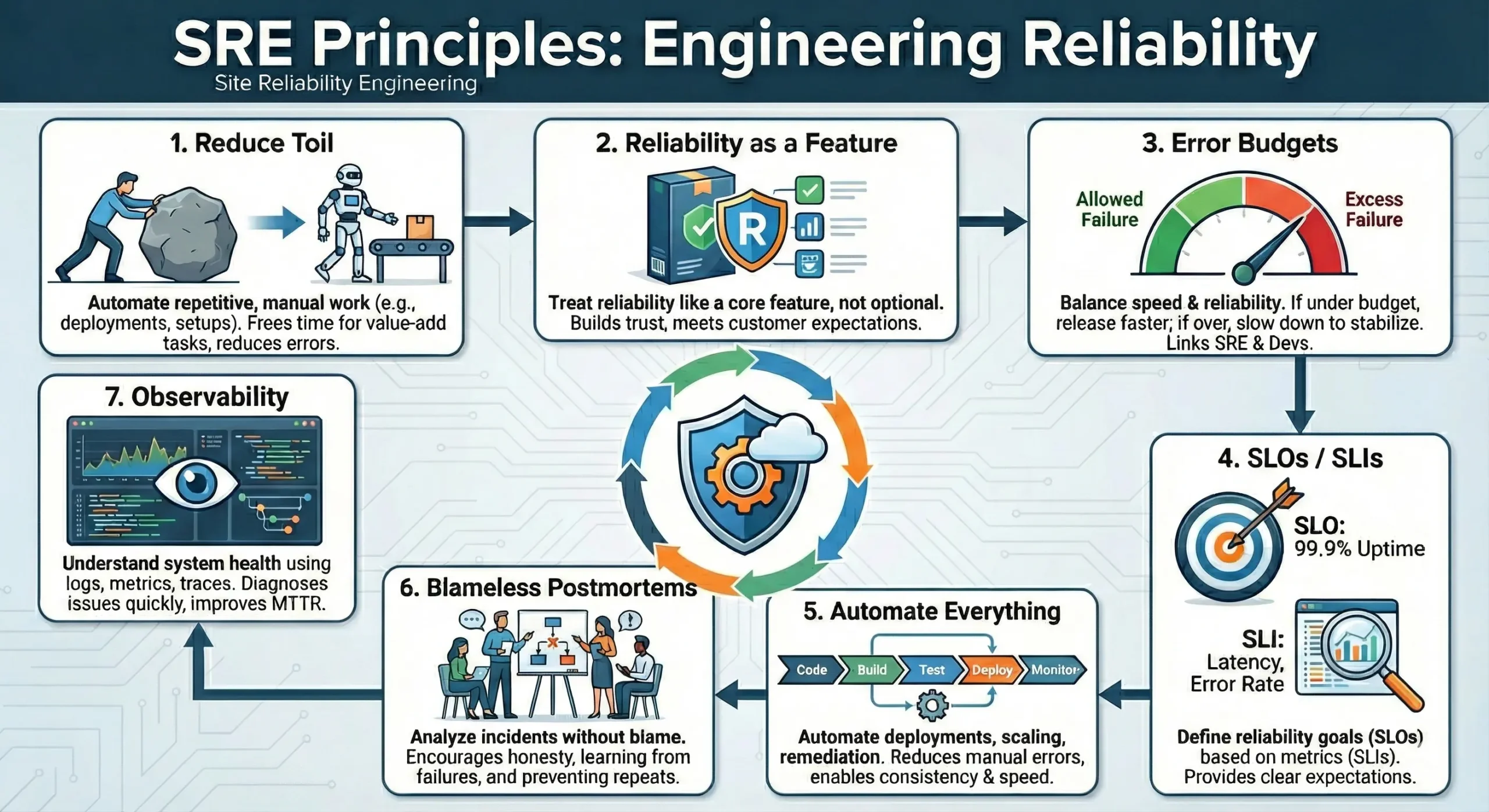
- SRE Principles.
-
Reduce toil.
-
Reliability as a feature.
-
Error budgets. - Use error budgets to balance speed & stability.
-
Define SLOs and SLIs.
-
Automate everything possible.
-
Use blameless postmortems.
-
Build strong observability.
- SRE helps organizations run large-scale systems with: -
-
High reliability.
-
Better performance.
-
Faster recovery.
-
Lower operational cost.
-
Strong automation.
-
Clear reliability targets.
> SRE creates a perfect balance between development speed and system reliability, helping organizations deliver consistent and dependable services.
For more details click here.
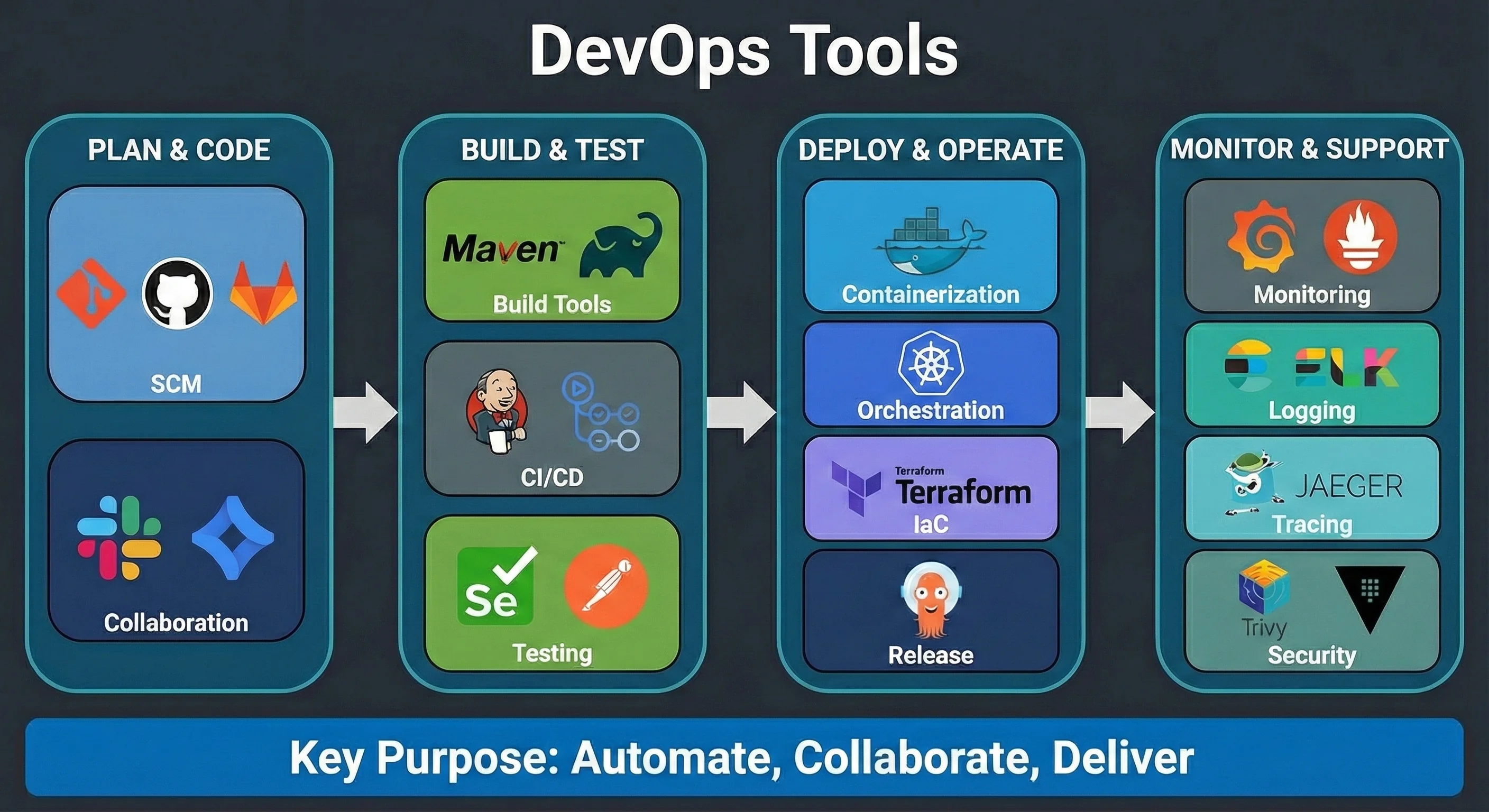
11. DevOps Tools
By selecting the right categories, teams create a strong toolchain that supports automation, collaboration, and fast delivery without depending on any single tool.
**CategoryToolsPurpose****Source Code Management (SCM)**Git, GitHub, GitLab, Bitbucket, Azure Repos, CodeCommit.Store code, track changes, team collaboration.Build ToolsMaven, Gradle, Ant, Bazel.Compile code, build artifacts, run unit tests.CI/CD ToolsJenkins, GitHub Actions, GitLab CI, Azure Pipelines, CircleCI, CodePipeline.Automate build → test → deploy pipeline.ContainerizationDocker, Podman, containerd, CRI-O.Package apps into lightweight containers.Container OrchestrationKubernetes, EKS, AKS, GKE, OpenShift, Rancher, Nomad.Manage container deployments, scaling, service discovery.**Infrastructure as Code (IaC)**Terraform, CloudFormation, Pulumi, Crossplane, opentufu.Create cloud infrastructure using code instead of manual clicks.Configuration ManagementAnsible, Puppet, Chef, SaltStack.Install software, manage configuration across servers.Artifact RepositoryNexus, Artifactory, GitHub Packages, ECR, Docker Hub.Store artifacts, Docker images, packages.**Monitoring (Metrics)**Prometheus, Grafana, Datadog, New Relic, ZabbixMonitor CPU, memory, performance, uptime.LoggingELK Stack, EFK, Splunk, Graylog, LokiCollect logs, search logs, troubleshoot issues.TracingJaeger, Zipkin, OpenTelemetry.Track requests across microservices for debugging.Secrets ManagementVault, AWS Secrets Manager, Azure Key Vault.Store passwords, tokens, API keys securely.DevSecOps / SecurityTrivy, SonarQube, Snyk, Semgrep, OWASP ZAP, DependabotScan code, images, dependencies for vulnerabilities.Cloud PlatformsAWS, Azure, GCP.Host applications, servers, databases, Kubernetes.Service MeshIstio, Linkerd, Consul, App Mesh.Secure service-to-service communication, traffic control.Collaboration & ChatOpsSlack, Teams, Jira, Trello, Confluence.Team communication, project tracking, documentation.Testing ToolsSelenium, Postman, JMeter, Cypress, pytest, JUnit.UI testing, API testing, performance testing.Release ManagementArgo CD, Flux CD, Spinnaker, Octopus Deploy.Manage deployments, rollbacks, GitOps workflows.GitOps ToolsArgo CD, Flux CD, Jenkins X.Manage infra/deployments directly from Git repos.Serverless ToolsLambda, Azure Functions, Cloud Functions, Knative.Run code without managing servers.API GatewaysKong, AWS API Gateway, NGINX, Traefik.Manage API routing, throttling, authentication.Backup & DRVelero, AWS Backup, Veeam, Rubrik.Backup data, restore clusters, disaster recovery
Here is some of popular tools, this list is not limited, there are many more tools are there in market, and new tools are on its way.
12. DevOps Learning Roadmap.
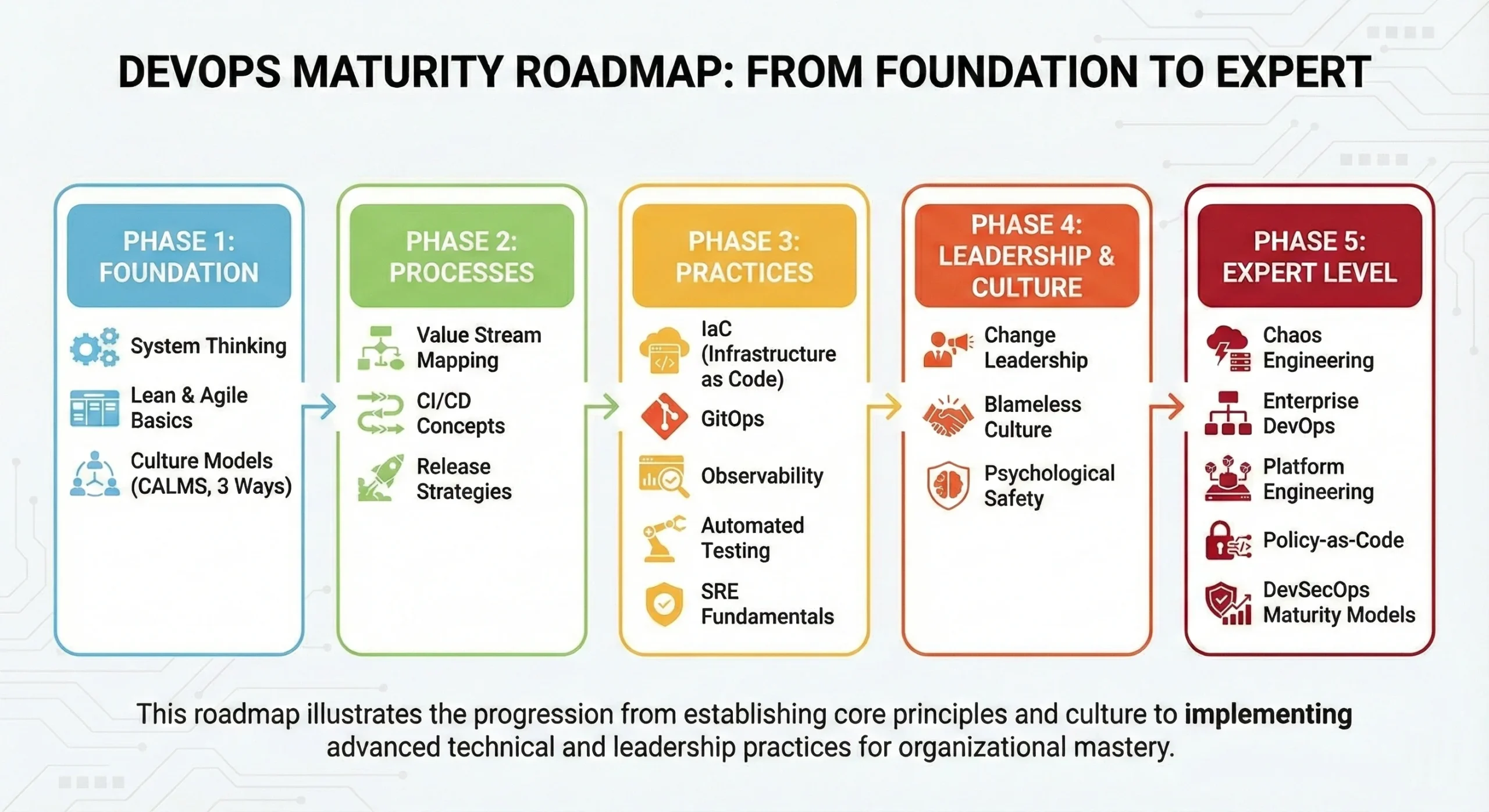
DevOps learning tools and techniques.
TopicWhat to LearnPractical ExampleLinux BasicsBasic commands, directory structure, file permissions, users/groups, SSH, environment variables, systemd services, process management, package managers (apt/yum), log files.Install & start NGINXNetworking FundamentalsIP, subnetting, routing basics, DNS records (A, CNAME, TXT), HTTP/HTTPS, ports, firewalls, load balancing, SSL certificates.Set up a domain with DNS + SSL certificateGit & GitHubGit workflow, branching strategy, pull requests, merge conflicts, tagging, rebasing, GitHub Actions basics, webhooks.Create repo → push code → PR → mergeScripting (Bash & Python)Bash variables, loops, conditions, functions, cron jobs, Python basics (modules, file operations, classes), APIs, automation scripts.Write script to backup logs dailyCI/CD ConceptsCI vs CD, build pipelines, test automation, artifact handling, deployment strategies (blue/green, rolling), pipeline stages, YAML pipelines.Build → test → deploy pipeline in Jenkins/GitHub ActionsBuild ToolsMaven lifecycle, pom.xml structure, Gradle basics, dependency management, build profiles.Build Java/Maven project and generate a .jar fileContainerization (Docker)Dockerfile creation, layers, image optimization, containers vs VM, volumes, networks, multi-stage builds, Docker ComposeCreate Dockerfile for Node.js/Python appKubernetes (K8s)Core objects (Pod, Deployment, Service), Ingress, API Gateway, ConfigMap, Secrets, Persistent Volumes, RBAC, Namespaces, HPA, Taints/Tolerations, Probes, Admission controllersDeploy app on Minikube or EKSInfrastructure as Code (IaC)Terraform syntax, providers, resources, variables, outputs, workspaces, modules, remote state, lifecycle rulesCreate VPC + EC2 + Security Group using TerraformCloud Platform (AWS/Azure/GCP)Compute, Storage, Database, Load balancers, Auto-scaling, IAM, Networking, Serverless, Monitoring, Billing basicsHost website on EC2 + S3 backupMonitoring & LoggingPrometheus metrics, Grafana dashboards, alert rules, ELK/EFK logs, structured logging, distributed logging, CloudWatch metrics/logs.Monitor CPU & memory and show graphsDevSecOps ToolsVulnerability scanning (Trivy, Snyk), SAST (SonarQube), DAST (OWASP ZAP), secrets scanning, dependency scanning, container security, policy enforcement (OPA, Kyverno).Scan Docker image for security issuesGitOpsGitOps principles, declarative infrastructure, ArgoCD/Flux sync policies, auto-rollbacks, environment promotion.Deploy a Kubernetes manifest using ArgoCDObservabilityLogs + metrics + traces, distributed tracing, Jaeger, OpenTelemetry, SLIs, SLOs, error budget calculation.Trace request across microservicesSoft SkillsCommunication, documentation writing, troubleshooting, on-call handling, RCA writing, collaboration.Write a simple RCA after an outage
Here is some of popular topics, this list is not limited, there are many more topics to learn.
13. DevOps Interview Preparation Material.
1. Cultural Questions.
-
Explain DevOps culture.
-
How do you build psychological safety?
-
What is blameless postmortem culture?
-
How do you reduce silos?
2. Leadership Questions.
-
How would you lead a DevOps transformation?
-
How do you handle resistance to change?
3. Process Questions.
-
Explain value stream mapping.
-
What are the Three Ways of DevOps?
-
Explain DORA metrics.
4. Mindset Questions.
-
Describe fail-fast philosophy.
-
What is systems thinking?
Quick remembering Cheat Sheet.
DevOps = Culture + Automation + Lean + Measurement + Sharing Goal = Deliver value faster, safer, continuously Foundation = Three Ways, CALMS Mindset = Flow, Feedback, Learning Leadership = Enable, not control Process = Value streams, CI/CD, automation Collaboration = Shared responsibility Outcomes = High performance (DORA metrics)
Happy Learning
Complete DevOps Summary in One
1 FOUNDATIONS & CULTURE
SubjectKey TopicsSummaryWhat is DevOps?Dev + Ops integration, automation, CI/CD, collaborationDevOps means Everyone working like one team. Faster delivery, fewer production issues, more stable releases. Automate everything builds, tests, deployments and release small, safe changes frequently. DevOps Mindset & CultureOwnership, no blame, experimentation, continuous improvementMindset is more important than tools. DevOps mindset encourages people to fix problems together, learn from mistakes and automate manual work. When blame culture is removed, people report issues early and improve systems faster. Do blameless postmortems, give teams freedom to try new ideas, and reward automation. Example: When production breaks, instead of blaming a developer, the team asks, “How can we prevent this next time?”DevOps LeadershipRACI, vision, support, removing blockersDevOps succeeds only when leaders support it. Teams need freedom, tools, training, and time to adopt DevOps. Remove unnecessary approvals, sponsor automation, allocate budget for CI/CD and cloud, set KPIs like deployment frequency and MTTR. Example: Leadership approves moving from manual deployments to automated pipeline.Agile + DevOps IntegrationScrum + CI/CD, Kanban flow, trunk-based devDevOps and Agile work together. Agile plans work in small chunks; DevOps delivers them safely using automation. Big releases fail, small ones succeed. Use trunk-based development (small PRs), CI pipelines running tests, and deploy at the end of every sprint. Example: Every story merged automatically goes to staging.
2 SOURCE CODE & COLLABORATION
SubjectKey TopicsSummaryGit & Branching StrategiesGit basics, trunk-based, GitFlow, PR rulesGit manages code versions. DevOps prefers trunk-based development because it avoids long-lived branches. Short branches = fewer merge conflicts + faster CI. Make small commits, raise small PRs, merge quickly. Example: A team merges 5–10 PRs daily, keeping code fresh.Code Review & Pull RequestsPR templates, approvals, quality checksPR reviews improve quality and team knowledge. Two minds catch more bugs than one. CI also checks code automatically. Use PR template → reviewer checks logic, tests, naming, security. Example: PR cannot merge unless tests and scans pass.
3 CI/CD & BUILD SYSTEMS
SubjectKey TopicsSummaryCI FundamentalsBuild automation, tests, fast feedbackCI runs every time a developer commits code. Early detection saves time. CI does compilation, unit tests, linting, security scans. Example: GitHub Actions runs pipeline on every PR.CD FundamentalsContinuous Delivery vs Deployment, release automationCD automates delivery to environments like dev/stage/prod. Removes manual risky steps. After CI passes → CD deploys to staging → optional approval → production. Example: Blue-green deployment switches traffic safely.Pipeline DesignStages, caching, parallel jobs, fail earlyA good pipeline is fast, reliable, and visible. Slow pipelines reduce productivity. Split pipeline into clear stages: Build → Test → Security → Package → Deploy. Use caching and parallel jobs to improve speed.Build Tools & PackagingMaven, Gradle, npm, Python, Go, artifact storageBuild tools compile and package apps. Standard packaging ensures consistent deployment. Use versioned artifacts stored in registries (e.g., v1.0.23). Example: .jar, .docker, .zip stored in S3 or Artifactory.CI Runners & AgentsHosted vs self-hosted, sandboxing, securityRunners execute pipeline jobs. Compromised runner = compromised system. Use ephemeral runners, restrict permissions, ensure cleanup. Example: GitHub ephemeral runner built per job.Pipeline Security BasicsSecrets, least privilege, signingSecure pipeline = secure supply chain. Attackers target CI. Never store secrets in code; use vault; sign artifacts; isolate runners.
4 TESTING & QUALITY
SubjectKey TopicsSummaryUnit Testing & TDDxUnit, mocking, fast testsUnit tests check small code pieces. Fast tests catch bugs before integration. Use TDD (write test → write code → refactor). Example: Test login function before coding it.Integration & End-to-End TestingREST tests, UI tests, staging testsIntegration tests validate how services work together. E2E tests ensure the whole system flows correctly. Real bugs appear only when combining components. Use Postman, Selenium, Cypress, etc.Test Automation StrategyTest pyramid, flaky test fixesUse test pyramid: many unit tests, fewer E2E tests. E2E tests are slow, flaky. Make small deterministic E2E tests; run heavy tests nightly.Code Quality & LintersStatic checks, formatting, best practicesLinters fix coding style automatically. Clean code reduces bugs. Enable linting in pre-commit hooks.Load & Performance TestingJMeter, k6, stress testsPerformance testing simulates user load. Prevents slow or crashing apps in production. Test 1000+ users, measure response time, tune DB queries.
5 INFRASTRUCTURE AS CODE (IaC)
SubjectKey TopicsSummaryIaC BasicsTerraform, CloudFormation, ARMIaC means writing cloud infrastructure in code. Infra becomes repeatable and version-controlled. Write Terraform → run plan → review → apply.IaC Best PracticesModules, DRY, remote stateGood IaC is reusable and predictable. Reduces mistakes. Use modules, avoid hardcoding, store state in S3/GCS, use locking.IaC ValidationPolicy-as-code, linting, testsValidate infra before applying. Misconfigurations cause breaches. Use tfsec, checkov, OPA policies.Immutable InfrastructureAMIs, image bakingImmutable infra never gets patched replaced fully. More predictable and easier rollback. Build AMI, deploy new servers instead of doing SSH and patching OS and App.
6 CONTAINERS & DOCKER
SubjectKey TopicsSummaryContainers BasicsDocker images, containersContainers package apps with dependencies. Works same everywhere. Build Dockerfile → run container → push to registry.Container Best PracticesMulti-stage, minimal images, non-root userOptimize images to be small, fast, and secure. Use Alpine base image, copy only needed files, run user-mode non root user.Container RegistriesPush/pull, versioning, taggingRegistry stores container images. Central place for deployment. Tag images properly (app:1.3.2) and scan for CVEs.
7 KUBERNETES ESSENTIALS
SubjectKey TopicsSummaryKubernetes BasicsPods, Deployments, Services, Ingress / gateway APIKubernetes automates running containers at scale. Handles crashes, restarts, scaling automatically. Deploy using YAML: Deployment → Service → gateway API / Ingress.Workload TypesStatefulSet, DaemonSet, JobsChoose correct workload type for use case. Example: DB → StatefulSet, background tasks → Job.Kubernetes NetworkingCNI, ingress / gateway API, service discoveryK8s networking connects pods internally and externally. Use Services for internal access, Ingress for public routing.Kubernetes StoragePV, PVC, storage classPersistent storage for stateful apps. Create PVC → bind to PV.Scaling & AutoscalingHPA, VPAAutoscaling adjusts resources automatically. HPA scales pods based on CPU or custom metrics.
8 OBSERVABILITY
SubjectKey TopicsSummaryObservability BasicsLogs, Metrics, TracesObservability = understand system behaviour. Configure logging, metrics (Prometheus) and tracing (Jaeger).LoggingStructured logs, ELK, retentionLogs help debug issues. Send logs to ELK/EFK, use JSON logs, define retention policy.Metrics & AlertsPrometheus, Grafana, SLOsMetrics show service health. Dashboards + alerts for latency, errors, CPU, memory.Distributed TracingOpenTelemetry, JaegerTrace requests through microservices. Helps find bottlenecks.Incident ManagementOn-call, runbooks, RCAHow teams react to outages. Maintain runbooks, conduct blameless RCA.
9 SRE PRACTICES
SubjectKey TopicsSummarySRE BasicsSLO, SLI, SLA, error budgetSRE ensures reliability using error budgets. Track uptime, latency metrics, set reliability targets.Capacity PlanningForecasting, scalingPredict future load. Analyze metrics → plan resources → autoscale.RunbooksSOPs, emergency stepsPre-written instructions for incidents.PostmortemsBlameless RCAUnderstand failures and prevent repeats.
10 SECURITY BASICS FOR DEVOPS
SubjectKey TopicsSummaryDevSecOps BasicsSecurity everywhere, automationBasic security foundation for DevOps.Secrets HandlingVault, env injection, rotationNever store secrets in Git. Use vault + rotate keys.Hardening & PatchingOS hardening, upgradesKeep servers and containers patched.Network & Service SecurityWAF, firewallsProtect apps from common attacks.
11 AUTOMATION & PLATFORM ENGINEERING
SubjectKey TopicsSummaryConfiguration ManagementAnsible, Puppet, ChefAutomate server configuration with code.Service DiscoveryConsul, etcdHelps microservices find each other.Job OrchestrationCronjobs, AirflowManage scheduled automation jobs.Deployment PatternsBlue-green, canary, feature flagsDeploy safely and gradually.
Up coming
Deployment Strategies
System architecture is designed (microservices, monolithic, serverless etc.).